%20-%20Edited.png)


Meta² Zymes - Project Summary


While enzymes are highly useful in various applications, their limited operational stability and
production costs have led to an extensive search for stable catalytic agents that will retain the efficiency,
specificity, and environmental-friendliness of natural enzymes. Despite extensive efforts, there is still an
unmet need for improved enzyme mimics and novel concepts to discover and optimize such agents.
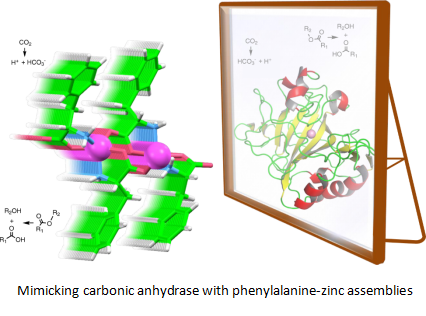
Inspired by the catalytic activity of amyloids and the formation of amyloid-like assemblies by
metabolites, our group pioneered the development of metabolite-metal co-assemblies that mimic the
catalytic function of common metalloenzymes with remarkably safe and simple building blocks.
Intriguingly, the assemblies exhibit high efficiency and exceptional robustness, even under extreme
conditions of temperature, pH, and salinity that are impractical for enzymes. Yet, we had only explored a
minute fraction of the chemical space as present in natural enzymes. In this project, we will perform the
first-ever systematic exploration of a vast combinatorial matrix consisting of metabolites and metal ions
that co-assemble into unique supramolecular catalytic active sites, analogous to the organization of
covalently bound residues and metal ions in conventional enzymes.
The work will involve advanced
experimental and computational techniques, including artificial intelligence-driven predictive modelling
based on functional, structural, and mechanistic data, to identify, optimize, and test the new nanozymes
in various relevant application scenarios.
Through this comprehensive study, we will not only identify
and characterize highly efficient nanozymes, but also gain fundamental insights into the evolution of
natural enzymes and design principles of catalytic nanomaterials.
This high-risk/high-gain project has the
potential to revolutionize the mimicking of enzymatic catalysis and develop robust, highly efficient, cost-
effective, and eco-friendly catalytic assemblies.